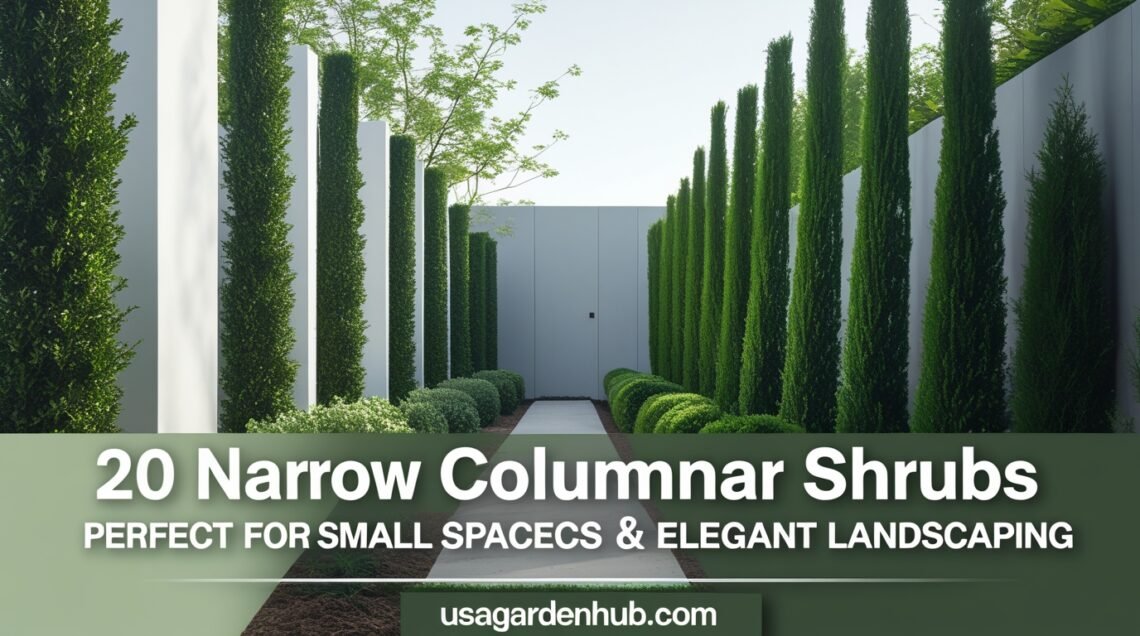
Discover 20 narrow columnar shrubs perfect for small gardens, privacy screens, and formal landscapes. Get growing tips and design ideas for these space-saving plants.

I’ll never forget the challenge I faced in my first townhouse garden—a narrow side yard barely three feet wide that seemed useless until I discovered columnar shrubs. These vertical wonders transformed that wasted space into a lush, structured garden that felt both private and expansive. After a decade of gardening in small spaces, I’ve found that narrow shrubs are the secret weapon for creating depth and interest without sacrificing precious square footage.
Columnar shrubs are plants that grow tall while maintaining a very narrow footprint, typically with upright, fastigiate habits. Unlike trees, they’re usually multi-stemmed and remain under 15 feet tall, making them perfect for foundation plantings, tight borders, and container gardening.
Why Grow Narrow Columnar Shrubs?
You should consider these slender shrubs because they solve common small-space dilemmas beautifully. They create natural privacy screens and windbreaks where wider plants won’t fit. Their upright forms draw the eye upward, making small gardens feel larger and more designed. Many are incredibly low-maintenance, requiring little pruning to maintain their shape. They also provide year-round structure, with evergreens offering constant color and deciduous varieties showcasing beautiful branching patterns in winter.
20 Top Columnar Shrubs for Your Garden
Here are my favorite narrow shrubs that deliver maximum impact in minimum space, complete with care requirements and design uses.
1. Sky Pencil Holly (Ilex crenata ‘Sky Pencil’)

This incredibly narrow holly grows 6-8 feet tall but stays a remarkably slim 1-2 feet wide. Its strictly upright, columnar form requires no pruning. Plant it in full sun to partial shade in well-drained soil. It’s perfect for flanking entries, growing in containers, or creating vertical accents in small gardens. According to the Missouri Botanical Garden, it’s particularly useful for narrow spaces and urban gardens.
2. Taylor Juniper (Juniperus virginiana ‘Taylor’)

A superior narrow juniper that grows 15-20 feet tall but only 3-4 feet wide. Its silvery-green foliage stays attractive year-round, and it’s both drought-tolerant and deer-resistant. Use it for screening, windbreaks, or as a tall vertical accent. It thrives in full sun and adapts to various soil conditions.
3. Fastigiate Boxwood (Buxus sempervirens ‘Fastigiata’)

This upright boxwood variety grows 5-8 feet tall and 2-3 feet wide, maintaining a narrow, columnar shape without frequent pruning. Its small, dark green leaves make it ideal for formal gardens, hedges, or parterre designs. It prefers partial shade and moist, well-drained soil.
4. Blue Arrow Juniper (Juniperus scopulorum ‘Blue Arrow’)

This striking juniper features silvery-blue foliage on a very narrow column that reaches 12-15 feet tall but only 2 feet wide. It’s exceptionally drought-tolerant once established and makes a perfect vertical accent in rock gardens or contemporary landscapes. The University of Florida IFAS Extension notes its value as a low-maintenance evergreen for difficult sites.
5. Columnar Blueberry (Vaccinium corymbosum ‘Blue Suede’)

Yes, you can grow columnar fruit bushes! This upright blueberry reaches 4-5 feet tall but only 2-3 feet wide, producing abundant berries while fitting into small spaces. It requires acidic soil and delivers stunning fall color. Perfect for edible landscaping in tight quarters.
6. Slender Silhouette Sweetgum (Liquidambar styraciflua ‘Slender Silhouette’)

While technically a tree, this incredibly narrow form grows 50 feet tall but stays only 4-5 feet wide. Its star-shaped leaves provide brilliant fall color, and its unique form is perfect for the tightest spaces. Use it as a dramatic exclamation point in small gardens.
7. Scarlet Spire™ Crabapple (Malus ‘Scarlet Spire’)

This narrow flowering tree/shrub hybrid grows 18 feet tall but only 6 feet wide, covered in pink buds that open to white flowers in spring. Its upright habit makes it perfect for small spaces where you want seasonal interest. According to the Morton Arboretum, columnar trees like this are ideal for urban landscapes.
8. Armstrong Juniper (Juniperus chinensis ‘Armstrong’)

A fast-growing option that reaches 10-15 feet tall and 3-4 feet wide. Its feathery, gray-green foliage and dense growth make it excellent for screening. It’s adaptable to various soils and highly drought-tolerant once established.
9. Columnar English Oak (Quercus robur ‘Fastigiata’)

This majestic but narrow oak grows 40-50 feet tall but only 10-15 feet wide—remarkably slender for an oak. Its upright branching pattern and dark green foliage make it perfect as a specimen in small lawns or for lining driveways.
10. Dawyck Purple Beech (Fagus sylvatica ‘Dawyck Purple’)

A stunning narrow tree that grows 25-30 feet tall and 10-15 feet wide, with deep purple foliage that holds its color all season. Its strong vertical lines and colorful foliage make it an outstanding focal point.
11. Emerald Colonnade® Holly (Ilex ‘Nellie R. Stevens’)

This improved narrow holly grows 12-15 feet tall and 3-4 feet wide, with exceptional density that makes it perfect for privacy screening. Its glossy green leaves and red berries provide year-round interest.
12. Fastigiate White Pine (Pinus strobus ‘Fastigiata’)

A narrow version of the Eastern white pine that grows 20-30 feet tall but only 8-12 feet wide. Its soft blue-green needles and upright habit work well as a specimen or screen in smaller landscapes.
13. Slender Hinoki Cypress (Chamaecyparis obtusa ‘Gracilis’)

This slow-growing conifer eventually reaches 8-12 feet tall but only 4-5 feet wide, with elegant, dark green foliage that arches gracefully. Perfect for Asian-inspired gardens or as a textural accent.
14. Columnar Norway Spruce (Picea abies ‘Cupressina’)

A very narrow spruce that grows 20-30 feet tall but only 6-8 feet wide, with dense, dark green foliage. Its fastigiate habit makes it ideal for windbreaks or screening in limited spaces.
15. Scarlet Oak ‘Splendid’ (Quercus coccinea ‘Splendid’)

This narrow oak grows 40-50 feet tall and 15-20 feet wide, with brilliant red fall color that’s exceptional for the species. Its strong central leader and symmetrical form make it perfect for street planting.
16. Pointe Maguire Juniper (Juniperus scopulorum ‘Pointe Maguire’)

An extremely narrow juniper that reaches 12-15 feet tall but stays only 18-24 inches wide. Its fine-textured, blue-green foliage maintains color year-round, perfect for the tightest spaces.
17. Fastigiate Ginkgo (Ginkgo biloba ‘Fastigiata’)

This narrow ginkgo grows 20-30 feet tall and 8-10 feet wide, with the species’ unique fan-shaped leaves that turn brilliant gold in fall. It’s pest-free and incredibly urban-tolerant.
18. Columnar Sargent Cherry (Prunus sargentii ‘Columnaris’)

A narrow flowering cherry that grows 25-30 feet tall and 8-12 feet wide, with pink spring flowers, attractive bark, and excellent fall color. Perfect where both flowers and narrow form are desired.
19. Swedish Aspen (Populus tremula ‘Erecta’)

This fast-growing columnar tree reaches 40 feet tall but only 10 feet wide, with leaves that quake in the breeze. Use it for quick screening or as a dramatic vertical element.
20. Armstrong Gold Maple (Acer × freemanii ‘Armstrong’)

A narrow maple that grows 40 feet tall and 12 feet wide, with brilliant orange-red fall color. Its upright branching pattern works well in contemporary landscapes or narrow lawns.
A Quick Guide to Selection
| Shrub Type | Height Range | Width Range | Best Use |
|---|---|---|---|
| Ultra-Narrow (Sky Pencil Holly) | 6-8 ft | 1-2 ft | Tight spaces, entries, containers |
| Medium-Narrow (Taylor Juniper) | 15-20 ft | 3-4 ft | Privacy screens, hedges |
| Narrow Trees (Columnar Oak) | 40-50 ft | 10-15 ft | Specimen trees, street planting |
5 Essential Tips for Success
- Check Mature Size: Always research the ultimate height and width. That cute 2-foot shrub might become a 15-foot giant. The USDA Plants Database provides reliable information on mature sizes.
- Plant with Purpose: Consider the shrub’s function—screening, accent, or structure. Place screening shrubs where you need privacy, and use accent specimens as focal points.
- Provide Adequate Space: Even narrow shrubs need room for air circulation. Don’t plant too close to buildings—generally stay 3-5 feet away depending on the mature width.
- Choose the Right Plant for Your Conditions: Check your USDA hardiness zone and soil type. The Lady Bird Johnson Wildflower Center offers excellent native plant suggestions.
- Consider Growth Rate: Fast-growing shrubs provide quick screening but may need more pruning. Slow-growing varieties often live longer and require less maintenance.
A Final Thought
Narrow columnar shrubs are the unsung heroes of small-space gardening, providing structure, privacy, and beauty without overwhelming your landscape. The key to success is choosing the right shrub for your specific space and conditions, then giving it the proper care during establishment.
For more design ideas using vertical elements, explore our guide to 20 Skinny Evergreen Trees. The North Carolina State Extension plant database also offers comprehensive growing information for many of these shrubs.
What narrow spaces are you looking to fill in your garden? I’d love to hear about your specific challenges and help you find the perfect columnar shrub solution. Share your thoughts in the comments below!